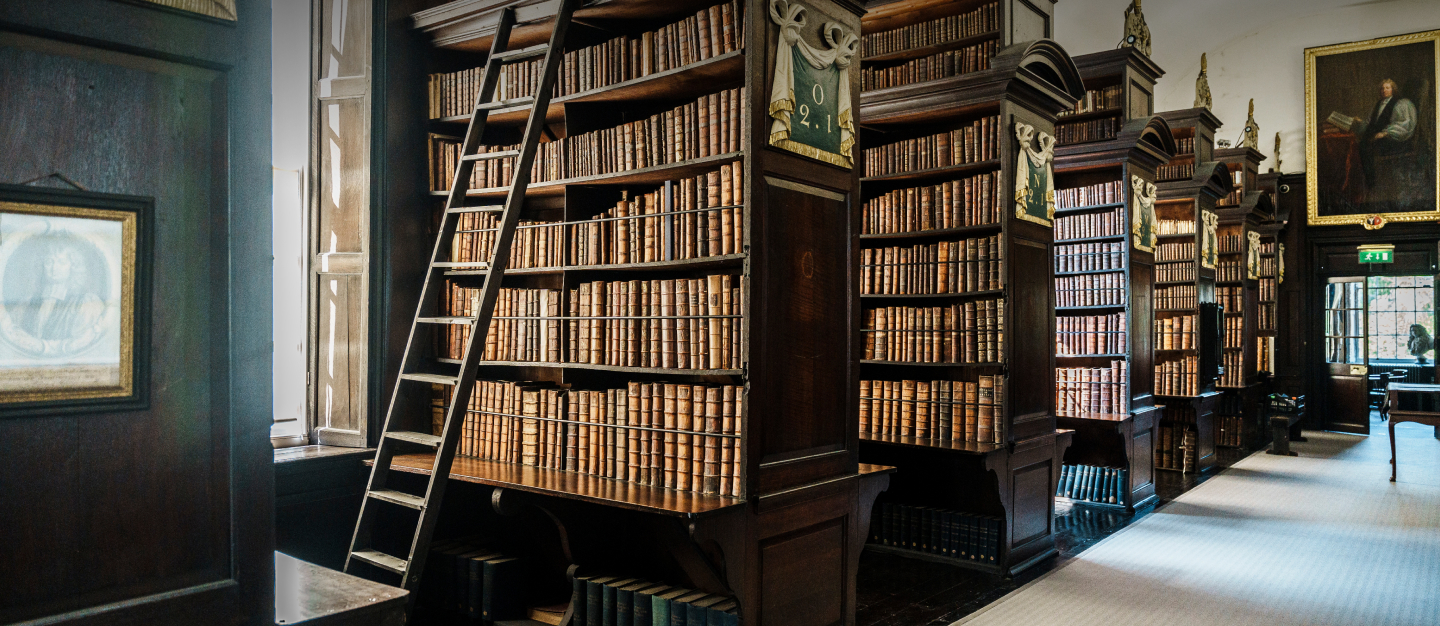
The Indigenous Worlds of Huguenot Colonization

Dr Joe Borsato
Recent Maddock fellow Joe Borsato discusses how Indigenous peoples shaped Huguenot colonization in the seventeenth century.
On 27 May 1603, the Innu (Montagnais), an Indigenous people of northeastern North America, met a group of Frenchmen who arrived near the confluence of the Saguenay and St. Lawrence rivers. Their leader, Anadabijou, told the French that he was ‘very glad’ that ‘His said Majesty should people their country, and make war on their enemies.’ Recorded in the writings of the French explorer Samuel de Champlain, Anadabijou’s words formed a basis for economic and political collaboration between the Innu and French from 1603 until the British conquest of French North America in 1760.
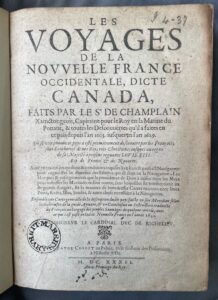
Title pages of Les Voyages de La Nouvelle France (Paris, 1632)
News of Anadabijou’s alliance-building efforts began circulating widely in print, most famously in Champlain’s Des Sauvages (1604) and later Les Voyages de la Nouvelle France (1632). In documenting the founding of the colony of New France in the St. Lawrence Valley, Champlain’s writings became highly sought-after texts, many of which can be found in the Bouhéreau and Stillingfleet collections at Marsh’s Library. Beyond simply describing unfamiliar peoples, these printed works revealed to wider European audiences that Indigenous alliances were key features of North America’s political environment.
Many of the French newcomers whom Anadabijou met had links to Huguenot networks. The 1603 expedition served under a royal grant to Pierre du Gua de Monts, a Protestant who had fought for Henri IV during the French Wars of Religion (1562-1598). Although Champlain himself outwardly conformed to Catholicism throughout his adult life, he nevertheless kept his connections with Huguenots, like de Monts, who became the lieutenant-general of New France and helped Champlain establish a fort at Port Royal in the territory of the Mi’kmaq in 1605. In 1610, Champlain married Helene Boullé, who came from a Huguenot family. Despite the French state’s barring of Protestants from settling in the Americas, Huguenot networks were a core part of the early French empire.
Indigenous peoples had interacted with Huguenots since the sixteenth century. Beginning in 1541, French Huguenots and Catholics tried to establish a colony in the St. Lawrence Valley under the command of Jean-François de La Rocque de Roberval, though that colony failed in part due to attacks from Laurentian-Iroquoian peoples who were neighbours of the Innu. Learning from Roberval’s failure, other Huguenots turned south to colonize in Florida and Brazil. Some, like Huguenot traveller Marc Lescarbot, associated with de Monts and Champlain, presented Indigenous-French alliances as worthwhile objectives. In his Histoire de la Nouvelle-France (1609), Lescarbot was keen to find ‘a sign of compact and perpetual alliance.’ For the Innu and French alike, an alliance provided the benefit of mutual defence.
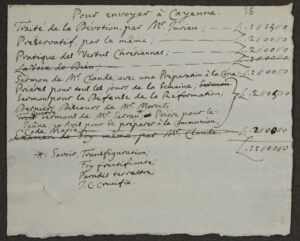
A List of books to send to Cayenne, Marsh’s Library MS Z2.2.16 (1.35). From the Letters of Élie Bouhéreau.
By 1700, Huguenot book collectors also sought to engage with the Indigenous Americas through the exchange of printed texts. In the late seventeenth century, Élie Bouhéreau, a Huguenot refugee from La Rochelle and the first librarian of Marsh’s Library, sent copies of Protestant sermons and treatises to Huguenots living in the French colony on the Cayenne River in South America, possibly out of a desire to evangelize Cariban peoples. Additionally, Bouhéreau’s cousin Élie Richard wrote the Histoire Naturelle (1700), which drew heavily on Lescarbot’s descriptions of the natural and political geography of North America. Long after their first entanglement, knowledge about the Indigenous Americas continued to move within Huguenot networks.
As a Maddock Fellow at Marsh’s Library, I was able to begin tracing these networks and connections, which allowed me to identify the ways in which Indigenous-Huguenot relations shaped colonization in the Americas. By contextualizing these networks, scholars and the public can better appreciate the central role that Indigenous peoples played in the process of European expansion.
Dr Joe Borsato, Queen’s University, Canada