Contextualising Élie Bouhéreau’s Diary

Dan Rafiqi
Dan Rafiqi places Élie Bouhéreau’s diary within the wider tradition of seventeenth-century autobiographical writing.
In 1685, Louis XIV, the ‘Sun King’ of France, revoked the Edict of Nantes guaranteeing Protestant freedom of worship, unleashing one of largest concentrated episodes of migration in early modern European history. Motivated largely by the desire to practise their faith freely, approximately 150,000 Huguenots fled France over subsequent decades, resettling across northern and central Europe and beyond. The psychic impact of this mass displacement was profound, affirming individuals’ sense that they were living through momentous historical times and prompting a range of challenging questions about identity and belonging.
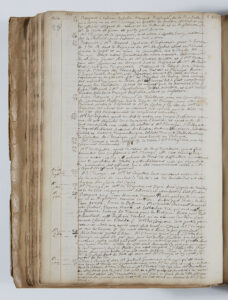
A page in Bouhéreau’s Diary describing his granting of passports to Huguenot refugees during his time serving as a secretary in Geneva.
It is perhaps no surprise that the Huguenots, steeped in a seventeenth-century textual memorial culture in which forms of personal storytelling such as memoir and livre de raison proliferated, gave rise to one of the richest traditions of pre-modern autobiographical refugee writing. This dynamic textual culture brought me to Marsh’s Library to examine the Diary (1689-1719) penned by its First Keeper Élie Bouhéreau, one of the lengthiest and most idiosyncratic self-narrated documents authored by a Huguenot refugee in the post-Revocation period. As a historian of the Huguenot diaspora, my overriding aim was to situate Bouhéreau’s sizeable diary within this wider tradition.
His experiences and aspirations certainly echo those of other Huguenot refugees, revealing shared concerns that shaped how they recorded and made sense of their lives in exile. Bouhéreau’s emphasis on his role in granting passports to his co-religionists fleeing France, for example, brings to mind the Mémoires of Henri de Mirmand, a patron of Huguenot exiles who recounted his efforts to aid refugees in Zurich and Brandenburg-Prussia. Elsewhere, Bouhéreau’s close attention to daily developments during the Siege of Casale (1694-5), observed during his role as a military administrator in the region, recalls the diaries of Huguenot refugee soldiers such as Isaac Dumont de Bostaquet and a certain ‘Lacoste’ who took up arms against their homeland.
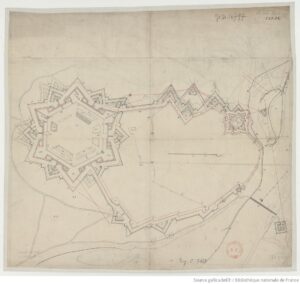
‘[Plan of the Fortified Town of Casale, Monferrato]’ (1695). Source: gallica.bnf.fr / Bibliothèque nationale de France https://gallica.bnf.fr/ark:/12148/btv1b8494489x
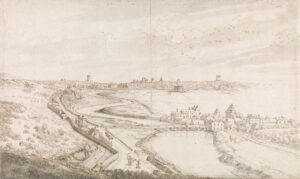
Place’s view of Dublin offers a rare contemporary glimpse of the city in which Bouhéreau had settled the previous year. ‘Dublin from Phoenix Park’ by Francis Place (1698). Source: National Gallery of Ireland Collection licensed under CC BY 4.0 https://onlinecollection.nationalgallery.ie/objects/10693/dublin-from-phoenix-park?ctx=83bc046d-ef3e-4d87-aa37-a6d2b01143e9&idx=1
One does not have to look far to find the origins of Bouhéreau’s particular preoccupations with memory. He was born into a family of pastors, a role long associated with curating cultural memory by French Protestants, and had, after all, witnessed a wave of political repression that threatened to efface his faith’s distinctive culture and history firsthand. His text, with its uncommon diary form and numerous reflexive musings, offers a distinctive, highly valuable reference point for understanding the lived experience of this upheaval and the ranging, sometimes contradictory ways migrants sought to curate those experiences for future readers. Ongoing research into his manuscript, alongside other Huguenot refugee accounts, is well placed to contribute to burgeoning cross-confessional scholarly interests in early modern refugee communities and the wider symbolic worlds through which those displaced in the past made sense of themselves and their experiences.
Daniel Rafiqi is a cultural historian of early modern migration. His research focuses in particular on the intersection between self-narration, memory and emotion. He is currently based in London.
Further Reading:
Élie Bouhéreau, The Diary (1689-1719) and Accounts (1704-1717) of Élie Bouhéreau, eds. Marie Léoutre et al. (Irish Manuscripts Commission, 2019).
Isaac Dumont de Bostaquet, Memoirs of Isaac Dumont de Bostaquet, a Gentleman of Normandy: Before and After the Revocation of the Edict of Nantes, ed. Dianne W. Ressinger (Huguenot Society of Great Britain and Ireland, 2005).
Lacoste, ‘Detail de mes etudes, voyages, campagnes et aventures qui me sont arriveés pendant le cours de 52 annees’ in Benjamin Lacoste, ‘Livre de ma genealogie et de celle de ma femme’ (1677-1732), MS Rawl. D. 452, Bodleian Library, University of Oxford.
Henri de Mirmand, ‘Mémoires’, in Alexandre de Chambrier, Henri de Mirmand et les réfugiés de la révocation de l’édit de Nantes, 1650-1721 (Attinger frères, 1910), 1-32.
Ruth Whelan, ‘Marsh’s Library and the French Calvinist Tradition: The Manuscript Diary of Élie Bouhéreau (1643-1719)’, in Muriel McCarthy and Ann Simmons (eds.) The Making of Marsh’s Library: Learning, Politics and Religion in Ireland, 1650-1750 (Four Courts Press, 2004).