‘Debate Bros’ at the French Court After the Wars of Religion

Dr Marc W. S. Jaffré
Dr Marc W. S. Jaffré explores how the French court of Henri IV navigated the presence of Catholics and Protestants, in the wake of the Wars of Religion.

Title page of Véritable Narré de la Conference Entre les Sieurs Du Moulin et Gontier (Geneve, 1625)
When Henri IV became king of France in 1589, it was in the midst of a bloody civil war. The Wars of Religion had been waging on and off since 1562, with bloody massacres on all sides of the conflict. Paris was in enemy hands, royal coffers were depleted, and Henri’s Protestantism remained a major obstacle to peace.
While historians have increasingly been interested in processes of reconciliation, pacification and peacebuilding in France after the Wars of Religion, the Edict of Nantes (1598) imposing the toleration of Protestant worship under specific conditions in France generated a new problem for the royal court: how to accommodate a significant Huguenot (Protestant) population within the court. Indeed, when Henri became king of France, many of the retainers who had worked in his household when he was merely king of Navarre (many of whom were Protestant) were folded into the French royal household upon his accession. This meant that for the first time since the outbreak of war, the royal court was composed of Catholics and Protestants alike, and this state of play continued even after Henri’s conversion to Catholicism in 1593. This bi-confessionalism created problems at a time when tensions between Catholics and Protestants remained high, and in a court whose structures and rituals were Catholic in their design. What adaptations were made to court rituals and structures to accommodate Protestant courtiers? How were religious tensions navigated at court?
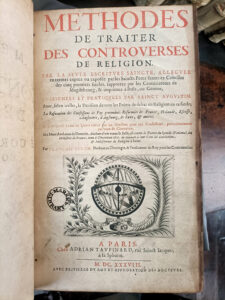
Title page of Methodes de Traiter des Controverses de Religion (Paris, 1638)
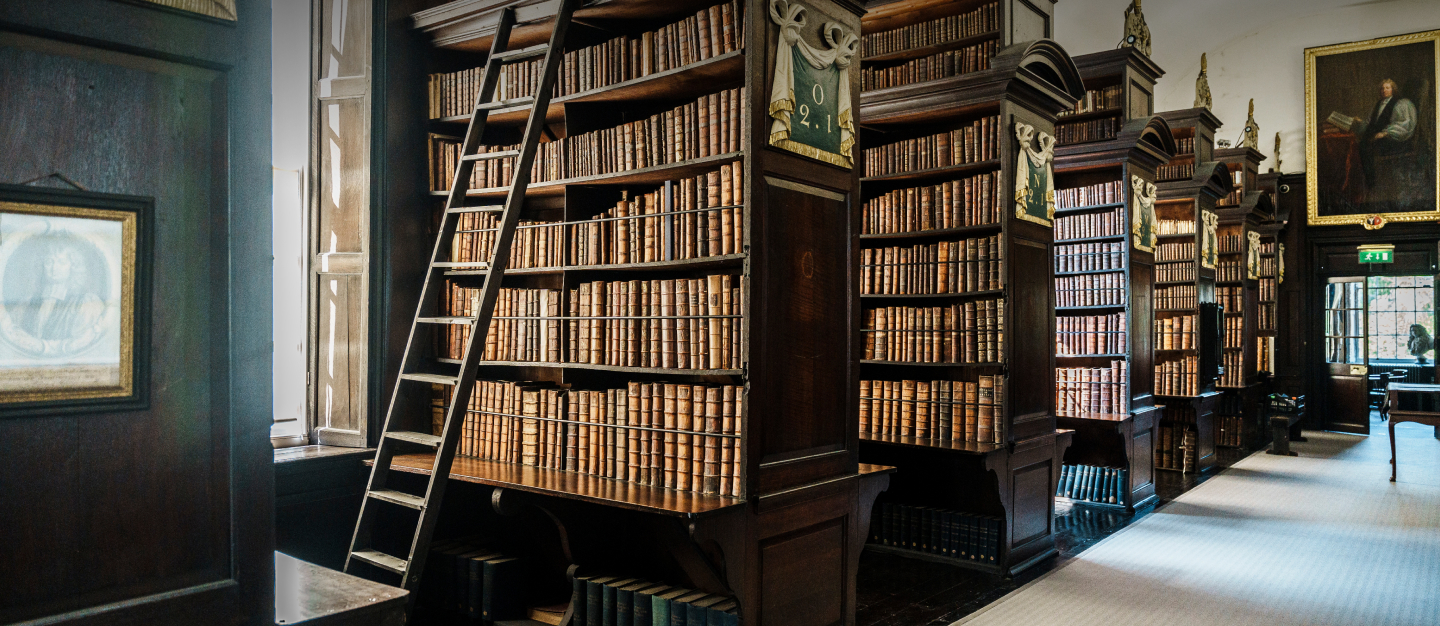
It is with these questions in mind that I visited Marsh’s Library in Dublin in February 2026 as a Maddock Research Fellow. Marsh’s Library houses an extraordinarily rich collection of pamphlets and books relating to court life under Henri IV and his successor Louis XIII, including polemical print campaigns, accounts of religious debates, printed sermons composed by royal clerics, parodies of court life, and news and gossip publications. This research, which builds on previous archival work in France and in London for my book, The Courtiers & the Court of Louis XIII, 1610–1643 (Oxford University Press, 2025), is still ongoing.
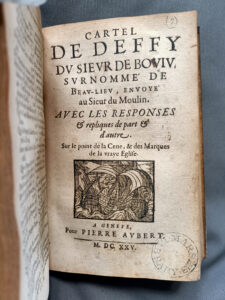
Title page of Cartel de Deffy du Sieur de Bouiv… (Geneva, 1625)
Reading through the pamphlets at Marsh’s Library, I was immediately struck by the way in which formal religious debates organised at the court mirrored aspects of ‘debate bro’ culture today, from an emphasis on performance and rhetoric to the taunting tactics and ad hominem attacks used to provoke debates. The published versions of the debates further demonstrate the extent to which sixteenth- and seventeenth-century debaters were keen to manipulate and shape the afterlife of their performances. While some courtiers argued that these debates channelled religious tensions into peaceful contests, others wanted them banned, fearing that they risked upsetting the delicate concord achieved at court. Clearly, these pamphlets show how complicated it was to build a bi-confessional court after decades of civil war, and that for some court preachers and their backers, pursuit of fame and their personal egos outweighed any risk of reigniting the bloody conflicts of the previous decades.
It would be remiss of me not to mention the exceptional hospitality offered by the team that welcomed me at Marsh’s Library. Too often, research trips abroad of this kind can be lonely experiences. But not at Marsh’s Library. I was extremely grateful for the conviviality and sociability of the team there, and this contributed greatly to the success of the research.
Dr Marc W.S. Jaffré is an honorary fellow of Durham University and the Deputy Chair of the European Branch of the Society for Court Studies. From September 2026 he will be leading a new research project on hospitality in Early Modern France and Tokugawa Japan as a Global Marie Skłodowska-Curie Fellow.