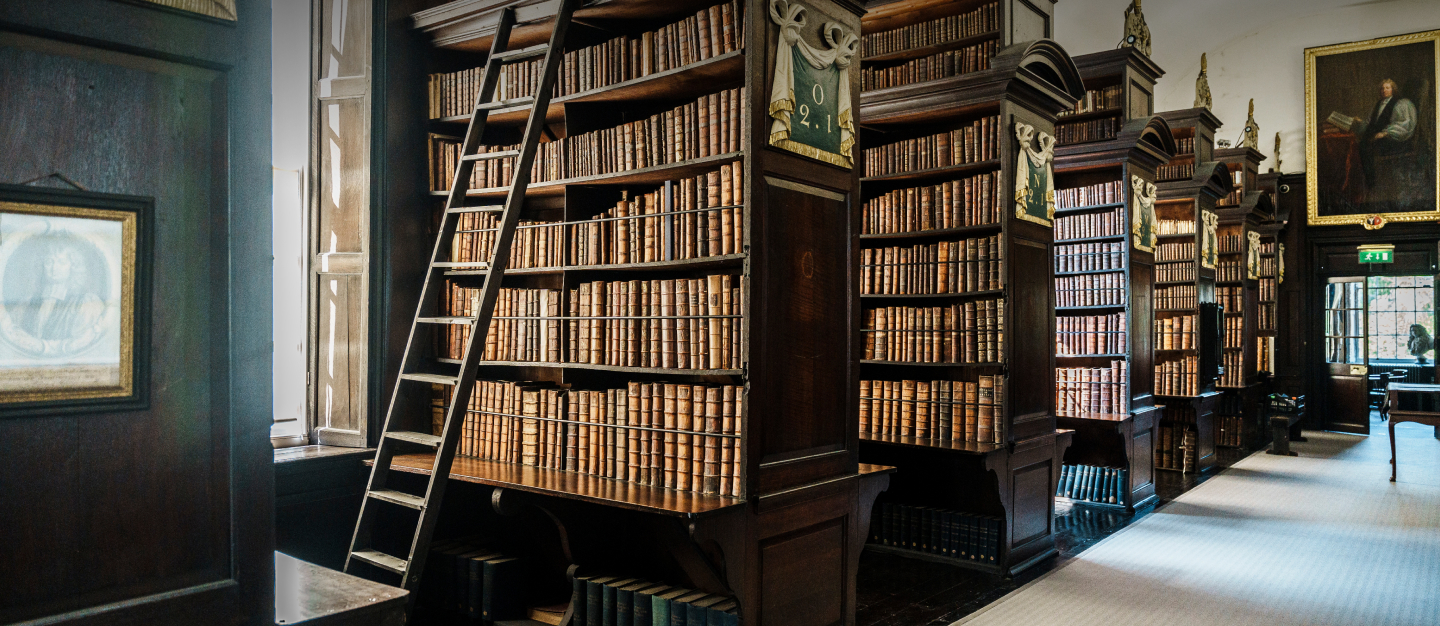
The Goose at Stake

Dr Alexandra Ballová
Dr Alexandra Ballová examines books in Marsh’s on the Czech reformer, Jan Hus. She finds sympathisers and detractors among early readers, and shares what that can tell us about the ideological outlook of the books’ past owners.
When the Council of Constance burned Jan Hus (1369–1415) at the stake in 1415, it sought to extinguish both the man and his teachings. Yet a century later, Protestant reformers were claiming him as a martyr and precursor of the Reformation, finding in his writings arguments that seemed to anticipate their own.
Among the works that advanced this interpretation was a collection of Hus’s letters, printed in Wittenberg by Johann Lufft in 1537 and prefaced by Martin Luther. It is one of more than a dozen Hussitica at Marsh’s Library that I examined during my Maddock Fellowship, tracing works by and about Hus through the collections of Edward Stillingfleet, Élie Bouhéreau, and John Stearne. Marsh’s holdings preserve both Protestant defences of Hus and Catholic attacks on his doctrines.
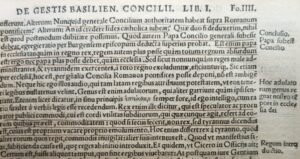
A section on the question of papal authority, from Fasciculus Rerum (Cologne, 1535)
I was looking for marginal notes, underlining, anything that showed someone had read these books. Many look barely opened. The only Hussitica in John Stearne’s collection, the Historia et Monumenta (Nuremberg, 1715), carries almost no sign of use. Stillingfleet’s copies are mixed. For instance, his Bellum Hussiticum (1621) is unannotated throughout.
Fasciculus Rerum (1535), on the other hand, features annotations by a sixteenth-century reader focusing on conciliarist arguments for papal subordination and deposition. The reader marked passages where Aeneas Sylvius, nearly two decades before he became Pope Pius II, argues that a general council stands above the pope and may depose him. The reader also highlighted descriptions of the Hussite movement, including the martyrdom of Jan Hus and Jerome of Prague, and the violent uprising of their followers against the institutional Church.
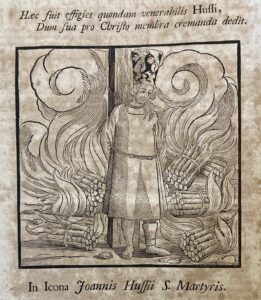
Woodcut showing Hus wearing the heretic’s crown, from Historia et Monumenta Joannis Hus…(Nuremberg, 1715).
The Fasciculus was not the only volume to attract this kind of attention. The 1537 Epistolae, prefaced by Luther, reveal the same interest in the limits of papal authority. A sixteenth-century reader underlined passages arguing against papal supremacy. He highlighted the claim that the Church stood headless during the supposed reign of Pope Joan, the legendary female pope; the contention that Peter was not the universal pastor; and the Isidorian dictum that a prelate who commands contrary to Scripture is a false witness of God and should not be obeyed. The title page bears the name Jacobus, whose precise identification remains a matter for further research.
The annotations reveal how readers engaged with these texts, but publishers and editors also guided their interpretation.
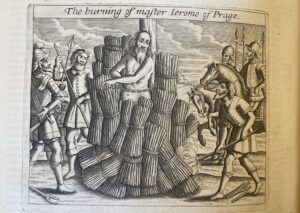
The martyrdom of Jerome of Prague, in John Foxe’s Acts and Monuments, known as ‘Foxe’s Book of Martyrs’, (London, 1684)
A large woodcut in Stearne’s copy of the 1715 Nuremberg reprint of Historia et Monumenta, shows Hus chained to the stake among the flames, wearing the tall paper crown the council set on him at his degradation. On the historical mitre that crown was painted with devils to brand him a heresiarch; the woodcut keeps the clawed devil-figures on the crown but carries no such word. The caption above the image describes it as the likeness of venerable Hus as he gave his body to the fire for Christ. The line below reads ‘In Icona Joannis Hussii S. Martyris’, while the accompanying verses greet him as the beloved Bohemian goose who outshines even the white birds in candour, a play on his name, since hus is the Czech word for goose. The image leaves the marks of humiliation in place and renames them a martyr’s attributes.
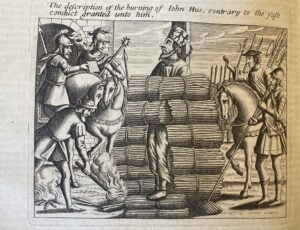
Jan Hus’ execution, from ‘Foxe’s Book of Martyrs’, (London, 1684)
This portrayal crossed into England, where John Foxe drew on it for his account of Hus and Jerome of Prague in his famous Book of Martyrs, first published in 1563. It appears again in Stillingfleet’s copy of the 1684 edition, where the engraving of Hus at the stake is captioned with the verdict that he was burned contrary to the safe conduct granted unto him. Assembled from three private collections, the Hussitica at Marsh’s preserve both the Protestant defence of Hus and the Catholic case against him. Some copies were closely read and argued with; others sat largely untouched. However, these unmarked volumes are equally revealing. For our early modern collectors, then, placing Hus on the shelf may itself have been an ideological statement.
Dr Alexandra Ballová is a special collections and rare-books specialist. In September 2026 she will take up a CERL Placement Grant to work on the incunabula collection at Pembroke College, Oxford.