Stillingfleet and the Modern Philosophers

Dr Stewart Duncan
Dr Stewart Duncan discusses anti-Spinoza literature in the Edward Stillingfleet collection.
Edward Stillingfleet was a bishop, a theologian, and a remarkable collector of books. He also found the time to argue with philosophers. Benedict Spinoza, meanwhile, was one of the great targets of early modern philosophical and religious criticism: the English clergyman and philosopher Samuel Clarke described him as ‘the most celebrated patron of atheism in our time’. Stillingfleet was among those who wrote against Spinoza.
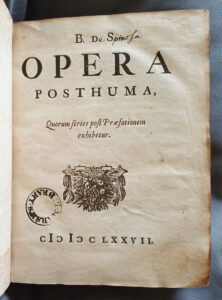
Title page of Opera Posthuma by Spinoza (Amsterdam, 1677)
Historians of philosophy know Stillingfleet principally as a critic of the work of John Locke. In fact, he read and wrote about several other modern philosophers, including René Descartes and seventeenth-century philosophers who reacted to Descartes’s views.
I am interested in what Stillingfleet thought about those philosophers, and in particular what he thought about Spinoza. Spinoza denied a fundamental belief shared by almost all his contemporaries, that God was something distinct from nature. Instead, Spinoza argued that there was fundamentally just one thing, which was both God and nature. This was one of the views that led to him being criticised so much.
During my Maddock Fellowship at Marsh’s Library, I looked at Stillingfleet’s copies of the works of several modern philosophers, including Spinoza, Descartes, and others, and also at his collection of anti-Spinoza literature from across Europe.
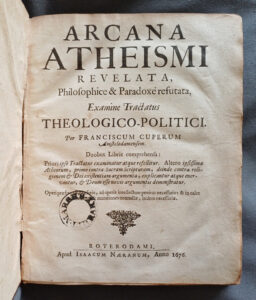
Title page of Arcana Atheismi by Kuyper (Rotterdam, 1676)
The Stillingfleet collection contains books by many prominent seventeenth-century philosophers. These include copies of Spinoza’s Tractatus theologico-politicus (1670) and his Opera posthuma (1677), the volume in which Spinoza’s famous Ethics were first published.
The collection also contains copies of anti-Spinoza literature that Stillingfleet owned. These include the Dutch publisher and author Frans Kuyper’s 1676 Arcana atheismi revelata; the anti-Spinozistic works of the Cambridge philosopher Henry More; the German theologian Christian Kortholt’s 1680 book on ‘the three imposters’ Herbert of Cherbury, Thomas Hobbes, and Spinoza; the French author Pierre Yvon’s 1681 book L’impieté convaincue, in which he argues at length against Spinoza’s Tractatus theologico-politicus; the 1685 L’impie convaincue of Noël Aubert de Versé, which objects to Spinoza by arguing that matter, like God, is an eternal being; and the remarkable 1690 Anti-Spinoza by Christoph Wittich, professor of theology at Leiden, which is a highly detailed commentary on Spinoza’s Ethics.
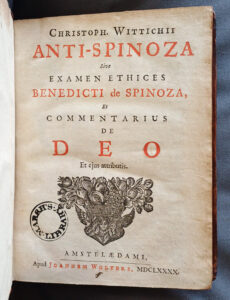
Title page of Anti-Spinoza by Wittich (Amsterdam, 1690)
With these and other books to hand, Stillingfleet was able to be very well informed about the European philosophical debates of his day. But he was not content just to read about them—he responded in writing to several of the most prominent participants, Spinoza included. Like many others, Stillingfleet thought that Spinoza’s view undermined morality—it ‘takes away all the real difference between good and evil’. But like Wittich or More, he did not just make moral criticisms of Spinoza, but also engaged critically with the details of Spinoza’s system and arguments.
Dr Stewart Duncan, professor in the Department of Philosophy of the University at Buffalo.