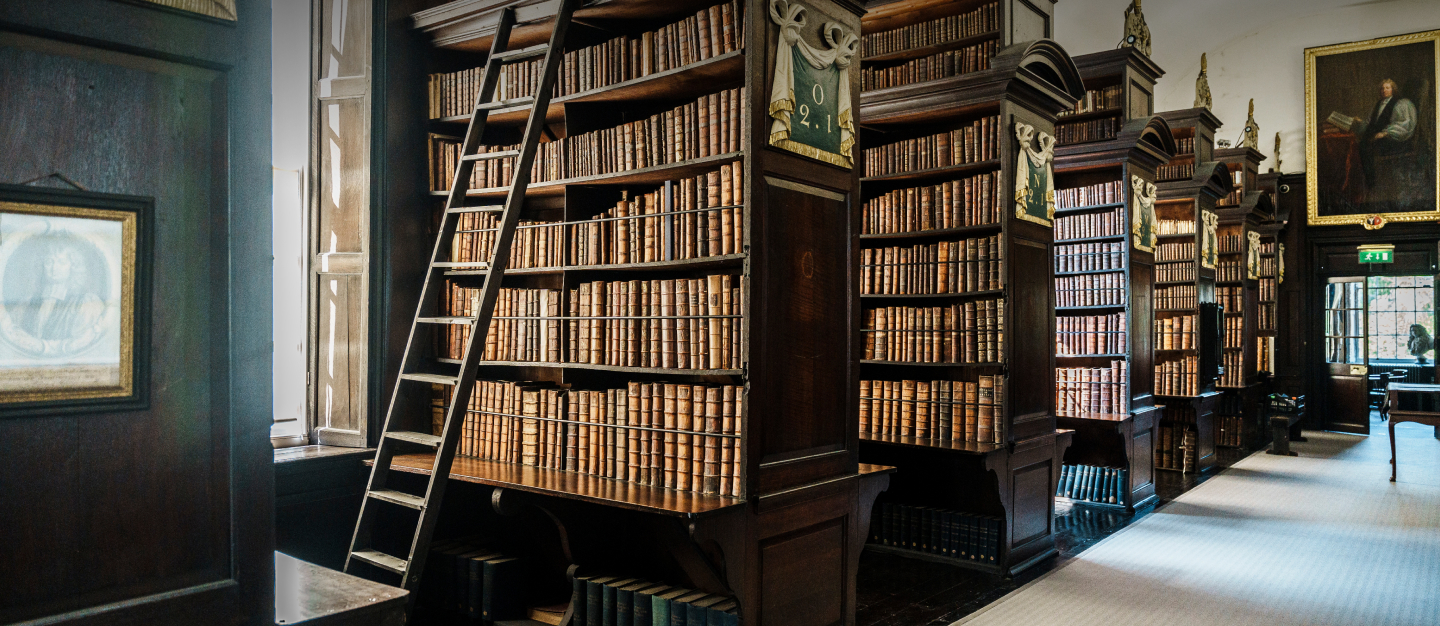
Encounters with Milton at Marsh’s Library
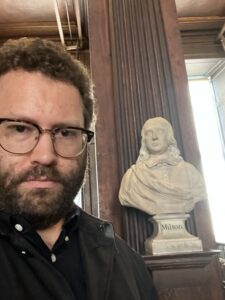
Dr. Thomas Matthew Vozar with a bust of John Milton in The Long Room at Trinity College Dublin.
During his recent Maddock Fellowship at Marsh’s, Dr Thomas Matthew Vozar looked at how early readers responded to John Milton’s radical prose writings.
If you hear the name John Milton (1608–1674), you will likely think first of the sublime epic Paradise Lost. But Milton was also a prolific author of prose, writing on matters ranging from the regicide of Charles I to theology. A political radical and a devout yet heterodox Christian, Milton throughout his writings manifests a deep concern with liberty, a theme which is perhaps nowhere more evident than in Areopagitica, his tract against the Licensing Order of 1643, which re-introduced the pre-publication censorship of books. It is this subject that forms the basis of my latest book in progress, provisionally entitled Liberty to Know: Free Speech and the Advancement of Learning from Areopagitica to the First Amendment, and my week at Marsh’s Library as a Maddock Research Fellow afforded me the opportunity to examine a selection of early modern books relevant to this project.

Edward Lightborne’s inscription.
Among the most interesting items were several examples of what book historians call a Sammelband, a term borrowed from German to describe a bound volume that gathers together multiple separately printed texts. First and foremost on my research agenda was a Sammelband containing six prose works by Milton, including his tracts in favour of divorce, his short piece Of Education, and the aforementioned Areopagitica. An ownership inscription in this volume (‘Edward Lightbourne his Booke 1647′) allows us to identify an early collector of Milton’s prose, and demonstrates how his controversial writings were read not only by friends and admirers but by ideological enemies—Lightborne turns out to have been a ‘malignant’ minister, a royalist unsympathetic to the parliamentarian revolutionaries, who was forced out of his post in favour of a more ‘godly’ successor shortly before acquiring this set of Milton’s radical writings.
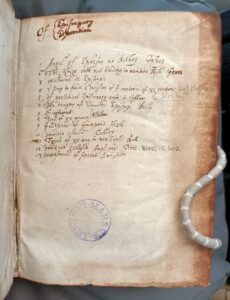
Table of contents in Of Prelatical Episcopacy, (London, 1641)
If the Lightborne volume exhibits one reader’s collection of Milton’s prose, other Sammelbands at Marsh’s Library (or Sammelbände, if you wish to insist pedantically on the German plural) provide evidence of the way Milton’s writings travelled, and in particular which other works accompanied them. One such volume features a table of contents at the front under the title ‘Of Episcopacy / Seperation [sic],’ and brings together three of Milton’s tracts calling for further reform of the Church of England—Of Prelatical Episcopacy, Of Reformation, and The Reason of Church Government—with pamphlets by others on the same topic, emphasising how Milton’s writings were read as part of this broader debate. Another volume includes Milton’s Of Education alongside texts on such subjects as the coal trade, swamp drainage, and husbandry—suggesting that the person who had these texts bound together understood Of Education as part of a wider discourse of economic and technological progress.
My research on these volumes and other books at Marsh’s Library, including copies of Nathaniel Carpenter’s Philosophia Libera (1621) and Johannes Meursius’s Areopagus (1624), is already helping me put together a fuller picture of the origins and influence of Milton’s prose and in particular the conception of intellectual freedom exemplified in Areopagitica. What will ultimately emerge from my visit as a Maddock Research Fellow is a new perspective on one of the most important texts in the Anglo-American free speech tradition, with its rousing call: ‘Give me the liberty to know, to utter, and to argue freely according to conscience, above all liberties.’ That is a freedom well worth understanding.
Dr. Thomas Matthew Vozar is Assistant Professor of Humanities at the Hamilton Center for Classical and Civic Education, University of Florida. His first book, Milton, Longinus, and the Sublime in the Seventeenth Century, was published by Oxford University Press in 2023.